
Aimee’s son Isaac had been given a devastating diagnosis, but he was determined
to run rings around it…

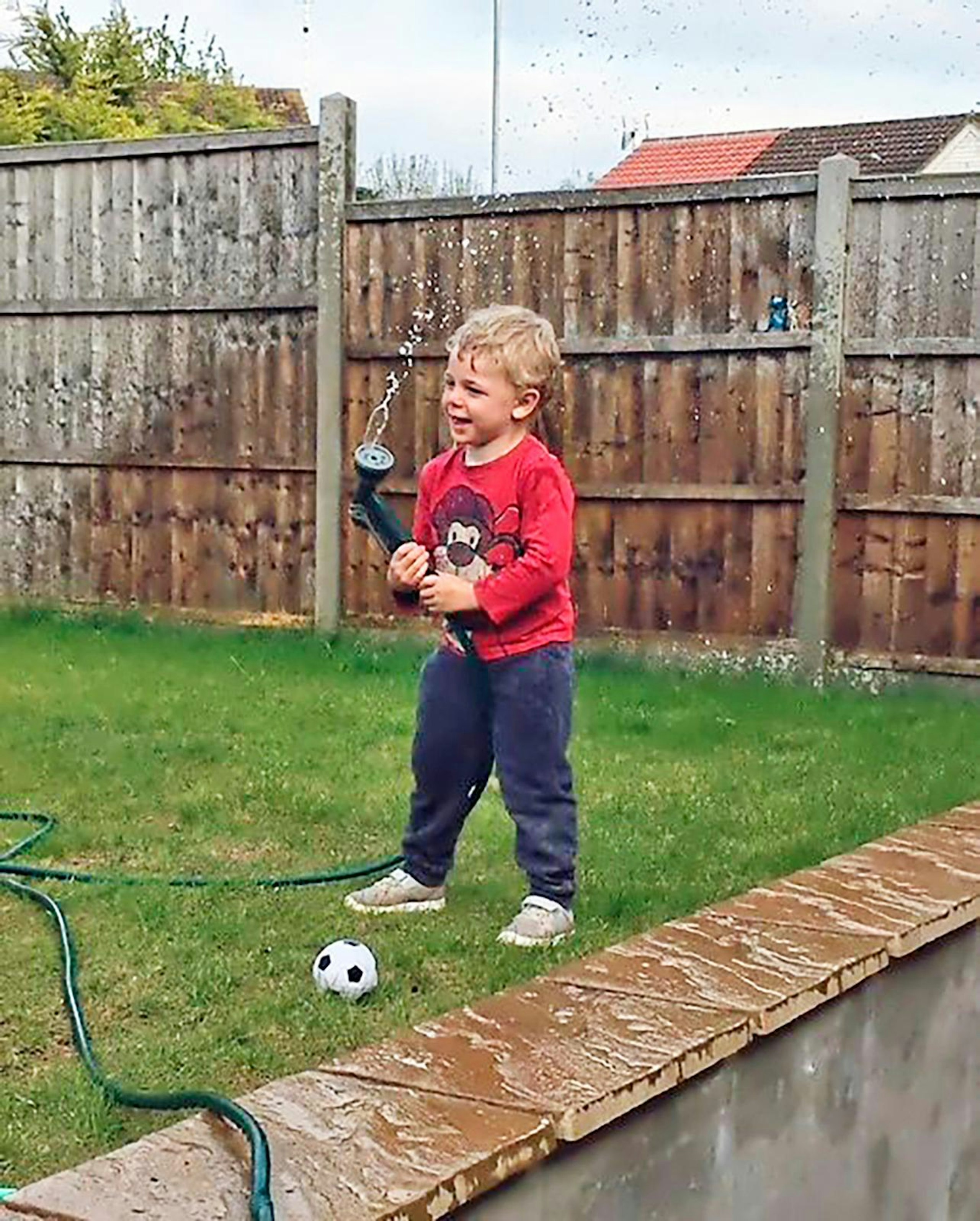
My two-year-old son confidently dribbled his football round the back garden, expertly weaving it this way and that.
‘I can’t believe how good he is,’ I said to my husband Adrian.
Isaac had already wowed all our friends, who were convinced he’d be playing in the Premiership one day!
He’d always been a bundle of energy.
If he wasn’t kicking a ball about, then he was climbing or running around.
But he adored his cuddles too.
Later that day, as he and his five-year-old sister Eva were sitting together on the sofa and Isaac gently rested his head on her shoulder, I felt a wave of contentment.
Just a few weeks on, I took Isaac for a routine check with the health visitor.
When she picked up that
he had a speech delay and suggested speech therapy, I wasn’t that worried.
Though his words still weren’t clear yet, I always knew exactly what he was saying and he’d hit all his other milestones early,
But when Isaac turned three, our world started falling apart…
We were on holiday with my in-laws in Hunstanton, Norfolk, and had driven to the seafront.
As we were about to get out of the car, Isaac said, ‘Mummy.’
Only it came out all slurred.
Suddenly his eyes glazed over and started twitching, and his body went floppy.
‘He’s not breathing properly!’ I said
to Adrian.
It was as if I was watching my son’s life slip away right
in front of me.
Frantic, Adrian scooped Isaac up and we ran towards a group of paramedics who happened to be working at
a seaside event.
'Can you bring someone with you?'
Isaac’s body was shaking violently and a paramedic confirmed it was a seizure.
Then, just as quickly as it had started, it stopped.
As Isaac came round, the relief
we felt was indescribable.
He was taken
to hospital where a CT scan came back all clear,
Later, we were told an MRI scan looked normal too.
But just 10 days on, Isaac suffered another seizure and was diagnosed with epilepsy.
Medication didn’t stop the seizures.
And as doctors tried different drugs, something more sinister was happening.
One day, when Isaac was four, I looked up to see him walking towards me taking long wide steps with his arms stretched out as if to steady himself.
And just like that his walk began to change.
Adrian and I worried it was side-effects from his medication.
But because of the Covid lockdown, doctors’ appointments weren’t face-to-face.
Feeling helpless, I filmed Isaac walking, but unable to see him in person, medics still weren’t convinced it was the medication.
Meanwhile, we were waiting for the results of the intensive blood tests he’d had.
Eight months after Isaac’s gait first changed, we were due for a face-to-face appointment at hospital.
But that very morning, a nurse called and said, ‘Can you come in earlier… and can you bring someone with you?’
I knew then it was bad news.
But nothing could have prepared us for what we were told when we got there.
‘Isaac has CLN2 Batten Disease,’ the doctor said.
I listened, bewildered, as he explained it was a form of childhood dementia, and that our son would lose all his skills, as well as his sight.
Then came the phrase ‘life expectancy’.
‘How long does Isaac have?’ Adrian said, welling up.
‘I’m afraid that once symptoms begin, life expectancy is around six to 12 years of age,’ the doctor admitted.
It felt as if time had stood still.
It all just seemed too cruel.
Then something inside me snapped.
'Issac has a poorly brain'
I looked into Isaac’s beautiful blue eyes, brimming with such innocent joy, and I decided, No, this disease is not going to take him. Not my boy.
But a few days later, as I watched Isaac playing with his toys, I crumpled into tears.
‘Why are you crying, Mummy?’ Eva asked. ‘It’s not like Isaac is going to die.’
Mum was there and we just looked at each other, and both of us were crying now.
Eva was so young but she knew something was terribly wrong.
And I couldn’t hide it from her.
‘Isaac has a poorly brain,’ I began. ‘We don’t know exactly what’s going to happen, but we know Isaac isn’t going to make it to be a man like Daddy.’
I’m not sure just how much Eva understood but things progressed quickly.
Isaac had surgery to fit a device into his brain so he could receive infusions of a wonder drug called Brineura, that slowed down the progress of the disease in people with the condition.
Our family, friends, and local community all stepped up.
My sister created a fundraiser to help with all the adaptations needed in our house to look after Isaac safely.
We even needed a bigger bed so Adrian and I could sleep with him each night in case he had a seizure.
Another fundraiser enabled us to go to Disneyland Paris before Isaac lost his sight.
An amazing lady called Lucy organised the trip, which included a special breakfast with all the Disney characters.
Isaac couldn’t wait to hug them all – even Darth Vader!
But we couldn’t shut out reality forever.
Isaac started at a special school and six months in, he started using a walker
to get around and a specialised trike too.
Soon he lost his peripheral vision and could only see what was in front of him by tilting his head to the side.
Eventually, he could only see a few feet ahead of him.
It was heartbreaking.

When Isaac turned eight, Adrian came home one day with an unexpected proposition.
My husband loved taking part in Iron Man events.
‘They’ve got Iron Kids Wales coming up,’ he said. ‘Why don’t we enter Isaac?’
It was a ‘run only’ event for children aged three to 15 in Tenby, Pembrokeshire.
And when the organisers confirmed that Isaac could take part on his walker, it was all systems go.
‘Who’s going to run a race?’ I grinned to Isaac.
‘Meeee!’ he whooped, excitedly throwing his arms in the air.
The race was nine months away but it was touch and go if he’d be able to take part.
Just one month before the big day he needed an operation to fit a feeding tube.
But remarkably Isaac recovered in time.
On race day, Eva, Adrian, and my in-laws all watched from the sidelines as I took my place next to Isaac at the start of the 500m course.
We’d decorated his walker with posters that read, I can’t see you! Please cheer for me!
And the crowd did just that.
They clapped, cheered, and chanted, ‘Go Isaac. Go Isaac!’
as he pushed his walker along beaming with joy from start to finish.
It took him 10 minutes and when we crossed the finish line the place erupted in applause.
When the organisers gave him his medal, my eyes were streaming with tears of joy.
Six months on, Isaac is such
a happy boy.
He loves his big sister, his school, all his friends, and going swimming and out on his trike.
Although he’s almost blind now, I’m so grateful
that the Brineura medication gives him the quality of life he still enjoys.
We only learnt after Isaac’s diagnosis that learning difficulties alongside seizures are a major red flag for Batten Disease, and I’m doing my best to raise awareness.
Now, I always urge people to slow down and really take the time to appreciate life.
Because my brave boy’s battle has opened my eyes to what truly matters.
Aimee Tilley, 37, Kettering, Northamptonshire
● Aimee has started a podcast for those caring for children with additional needs. Follow Isaac on Instagram @isaac_fighting_battens_disease
● To find out more about Batten Disease visit bdfa-uk.org.uk