All I wanted was to have a baby. But what would my dream end up costing me? By Sophie Forbes-Perry, 43
Gazing at the waves lapping against the shore, I made a wish.
Please, I thought, please let it happen.
For the last two years, my husband Simon and I had been trying to start a family without success.
Now, as I headed for 40, I’d started to worry it might not happen at all.
We’d gone on holiday to Thailand to try to relax and unwind, but having a baby was my dream and it was all I could think about.
Then, when we got home, I made an amazing discovery.
‘It’s finally happening!’ I said to Simon, barely believing it. ‘You’re going to be a dad!’
We were overjoyed.
I was so happy I didn’t even mind when morning sickness struck and I had my head over the toilet bowl.
At nine weeks, we booked an early scan, excited to get a glimpse of our longed-for baby.
But as the sonographer swept the scanner over my tummy, she said, ‘I’m just going to ask for a second opinion.’
My heart sank.
I knew it wasn’t going to be good news, but it turned out to be devastating.
There was no heartbeat.
I’d suffered what was known as a missed miscarriage. The pregnancy had ended but there’d been no obvious signs of bleeding.
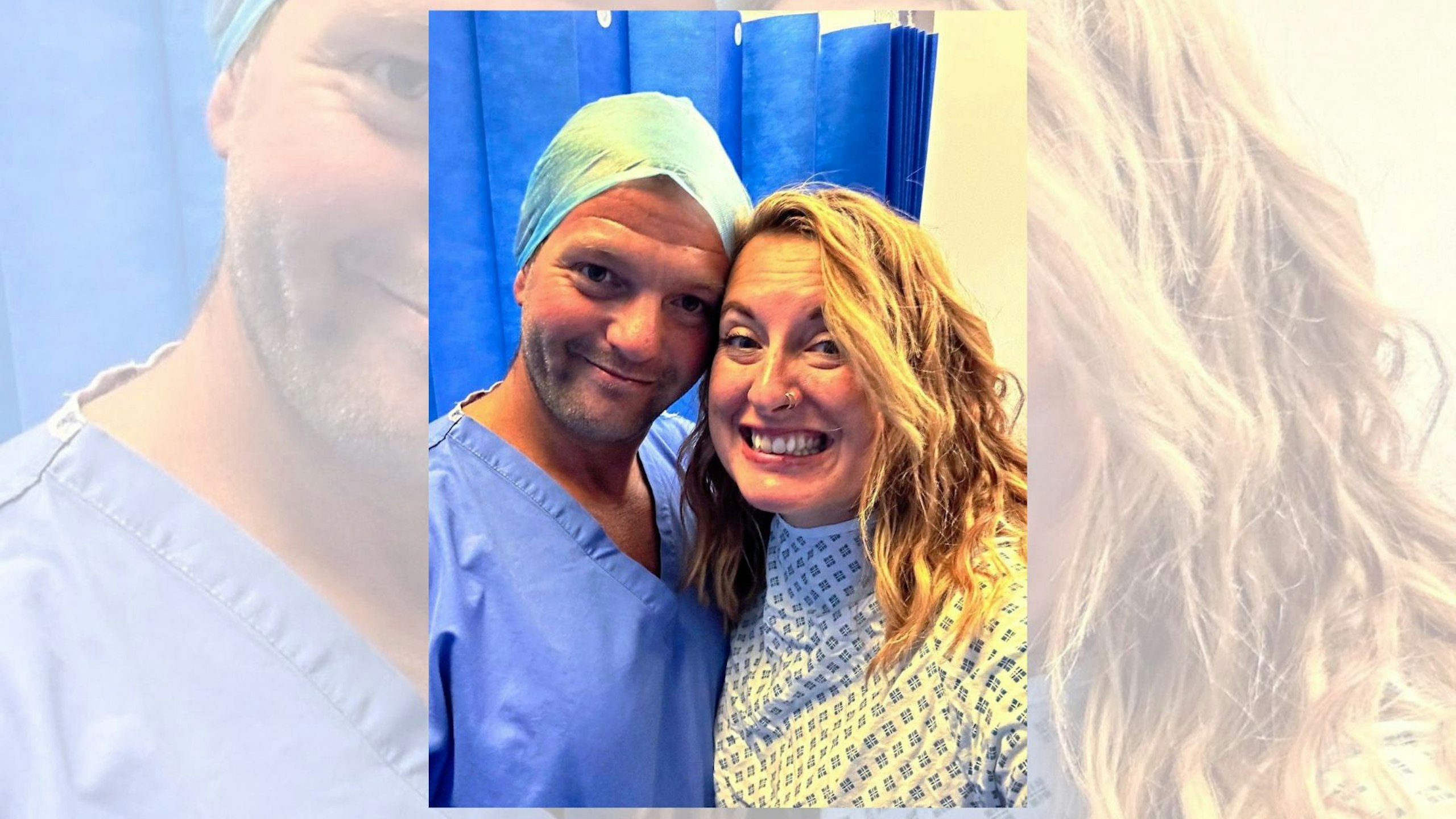
I had to have surgery to remove the foetus and it was an awful time.
Nine months later, though, I said to Simon, ‘I’m ready to try again.’
This time it took us three months to fall pregnant and once again we booked another early scan.
The sonographer peered at the screen and said, ‘I don’t know what I’m looking at.’
'We'll get through this'
Then came the words we’d been dreading.
‘I need a second opinion.’
I glanced at Simon anxiously.
When the sonographer returned, I braced myself.
I was having what was called a molar pregnancy. The baby and placenta had not formed, because of a problem with the fertilised egg.
I had been pregnant at some point, but now only tumours remained in my womb.
Again I had to have surgery to remove them, but a week on I was still being sick.
‘I don’t feel right,’ I said to Simon.
I was given antibiotics but they had no effect and I needed scans and blood tests.
Then I saw a consultant who said, ‘The tumours have come back.’
I didn’t know what that meant so, back at home in York, I did some research
and what I read left me reeling.
I discovered that the cells left behind by a molar pregnancy could continue to grow and become malignant.
I had another operation and days later my phone rang at home.
It was the hospital.
I knew they wouldn’t have rung unless it was urgent and, as I answered the phone, I said, ‘It’s cancer, isn’t it?’
‘Yes,’ the doctor replied.
I was numb, but I managed to phone Simon.
‘We’ll get through this,’ he said.
Doctors told me I was suffering from gestational trophoblastic disease, a rare condition which caused abnormal cells or tumours to grow in the womb during or after pregnancy.
In most cases the tumours turned out to be benign, but mine weren’t.
Getting pregnant had given me cancer.
Still reeling from the loss of the baby and the cancer diagnosis, I began chemotherapy.
It made me feel so ill, but I was relieved to hear that the cancer had not spread to any other organs.
But the consultant warned me, ‘Best not to get pregnant for a year in case there’s a risk of recurrence.’
By then, I was 41 and mindful of time slipping by.
Simon and I had been struggling to conceive for four years but, despite the heartache we’d suffered, I wasn’t ready to give up.
So we waited for a year and then I had a round of IVF, and an embryo was implanted.
But during a scan at 10 days, the sonographer again called for a second opinion.
The doctor explained that the quality of the embryo wasn’t good, and it looked more like a cyst.
It was one blow after another.
I’d suffered a miscarriage, a molar pregnancy, cancer, a year-long wait to try again and now the IVF hadn’t worked.
Yet, even then, I still had hope.
The doctor told us we might have success with a donor egg so we gave that a go and I was overjoyed when I began to have bouts of sickness. Even brushing my teeth made me gag.
But when I did a pregnancy test, the result was negative.
I was so confused.
‘I don’t understand,’ I said to my doctor. ‘I’ve got morning sickness but no baby.’
It turned out I’d lost the baby very early on because the embryo had not developed.
There had been a baby but now there wasn’t.
Now we had to make a decision to try again or accept the fact we’d never have a child.
‘Enough’s enough,’ I said to Simon. ‘We’re both worn out.’
He agreed.
It was time to start living
a different life from the one we’d planned and I became an ambassador for The Cancer Treatment and Research Trust, an organisation committed to
the research and management of rare cancers.
I also want to set up a group for couples who are childless for whatever reason.
I’ve gone through heartbreak, but it’s made me strong and I’m determined
to use that strength to help others.
• For more information visit heartandsoulwithsophie.co.uk and cancertreatment.org.uk